Workers’ Comp Attorneys in Orange County
Getting injured at work is a very real possibility for California employees, especially those in dangerous industries like construction, manufacturing, hospitality, healthcare, and transportation. When a workplace injury does occur, the workers’ compensation system makes it possible for employees to get the benefits they need – but not without a bureaucratic nightmare to deal with.
The Division of Workers’ Compensation (DWC) is muddled with layers of administration, paperwork, required forms, delays and one hand never seems to know what the other is doing. Compounding the problems with claims is that you may have disputes about adequate compensation, coverage and employer contribution. If you’re facing pushback on a workers’ compensation claim or dealing with a denied claim, a local attorney can help.
Explore our verified Orange County workers’ compensation attorneys to find the right one for your claim.
Orange County Workers’ Compensation Lawyers:

333 S Anita Dr Suite 855, Orange, CA 92868



3419 Via Lido, Ste. #607 Newport Beach, CA 92663
Helpful Information About Choosing a Workers’ Comp Lawyer
- You can research the Bar license status, suspensions or reprimands of an attorney at the California Bar Association website.
- The California Bar Association offers a “Specialty” certification for workers’ compensation for highly complex claims. It may not be necessary for you to work with a California Certified Bar Specialist in Workers’ Compensation law, but you should discuss the pros & cons of this with any attorney you talk to.
- Some attorneys will be able to meet with you at their office, the hospital, or over Zoom. It’s important to ask these questions when you call.
How Much do Workers’ Comp Lawyers Charge in California
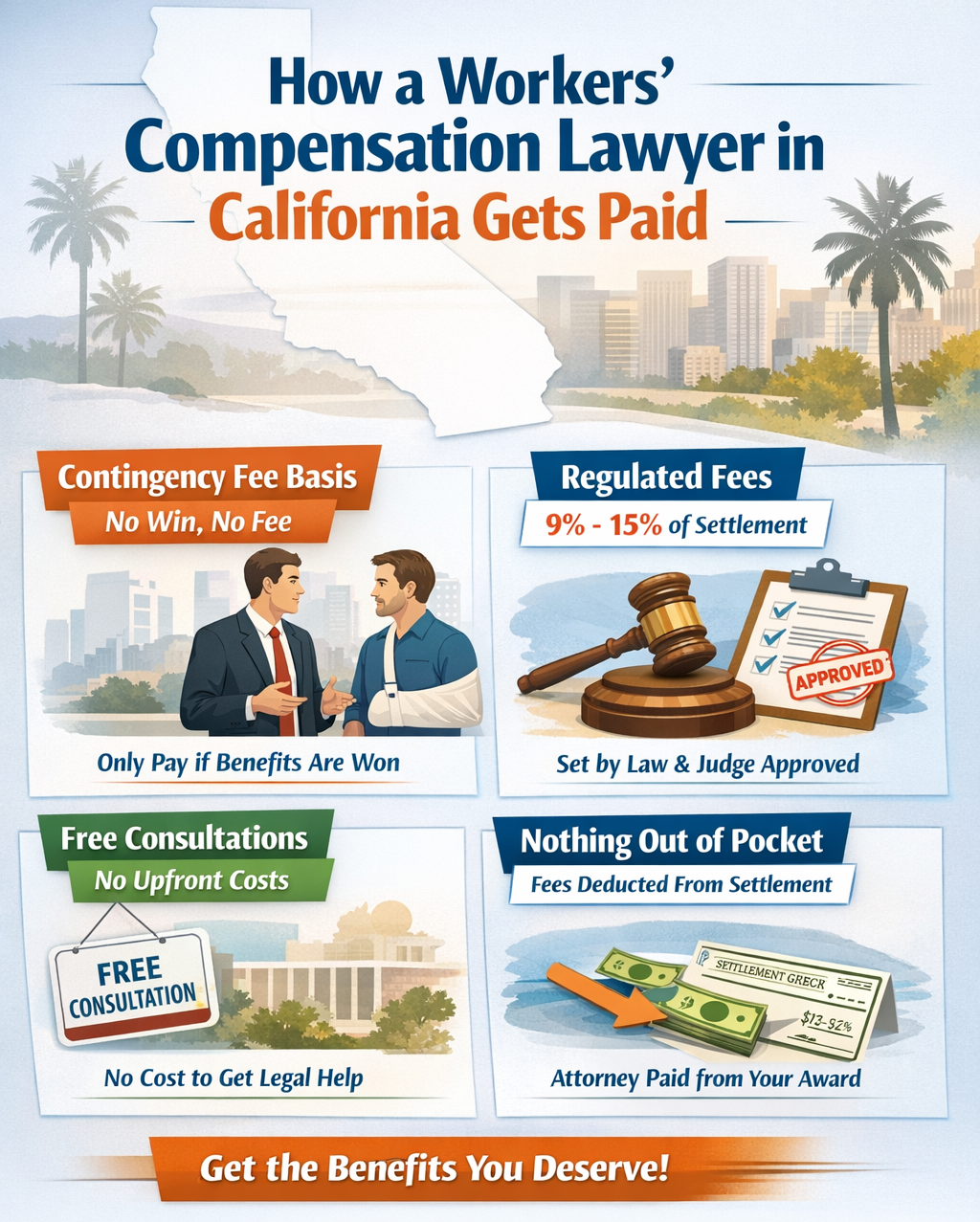 In California, workers’ compensation lawyers are typically paid on a contingency fee basis (“no win, no fee“), meaning they only receive a fee if they successfully obtain benefits for the injured worker. Unlike many other areas of law, attorneys in workers’ compensation claims do not charge hourly rates or upfront retainers. This structure ensures injured employees can access legal representation regardless of their financial situation.
Attorney fees in California workers’ compensation cases are strictly regulated by law and must be approved by a workers’ compensation judge. Fees generally range from 9% to 15% of the benefits recovered, depending on the complexity of the case and the work performed by the attorney. The fee is deducted directly from the settlement or award – not paid out of pocket by the injured worker.
Importantly, consultations with a California workers’ compensation lawyer are almost always free, and there is no financial risk in seeking legal advice. If no benefits are awarded, the attorney doesn’t get paid. This system is designed to protect injured workers while ensuring they have strong legal advocacy throughout the claims process.
What Can a Workers’ Comp Lawyer Do For You That You Can’t Do For Yourself?
In California, a workers’ compensation lawyer adds value primarily by handling legal, medical, and procedural complexities that an injured worker typically cannot manage effectively on their own. Most importantly, an attorney can develop and present medical-legal evidence – working with treating physicians, Qualified Medical Evaluators (QMEs), and other experts to properly document the extent of injury, permanent disability, and work restrictions in a way that meets statutory and evidentiary standards. This is critical because disability ratings and future benefits depend heavily on how medical findings are framed and reported.
An experienced attorney also navigates disputed claims and denial scenarios, including filing formal applications with the California Workers’ Compensation Appeals Board (WCAB), litigating issues such as compensability, apportionment, and benefit entitlement, and appearing at hearings or trials – tasks that require experience with procedural rules, deadlines, and evidentiary burdens. They can also negotiate settlements strategically, including structuring Compromise and Release agreements to account for future medical care, Medicare compliance issues, and the long-term value of the claim—areas where unrepresented workers often undervalue their cases.
How Workers’ Compensation Works in California
After an employee is injured, they report the injury to their employer. From there, they seek out medical care from an approved care provider while the employer files the claim with their workers’ compensation insurance provider. Once the claim is approved, the employee is entitled to receive medical care paid for by the insurance company, temporary disability payments, and other benefits as needed.
Other benefits include retraining coverage for employees who cannot return to their previous line of work, permanent disability for those who will never recover fully from their injury, and death benefits to family members of deceased employees.
The system protects both parties. Employees are guaranteed to receive limited income replacement and covered medical care. Employers are legally protected from personal injury claims.
Relevant Workers’ Comp Laws
California, known for its extensive workers’ rights, also grants them substantial protections in the workers’ compensation system. An employer is required to provide a claim form to an employee no later than one day after being informed of their injury. During that time-frame, they must also authorize medical treatment up to a total cost of $10,000 while waiting for the claim to go through the insurance company. The insurance company only has 90 days to deny the claim.
Denied Workers’ Compensation Claims
 Perhaps the most common legal issue that arises in this field is a denied claim. Workers’ compensation insurance companies have a wide variety of reasons for denying claims, but they often deny valid claims.
When this happens, the injured employee can take their case before a judge. This involves filing the Application for Adjudication of Claim, submitting necessary documentation, and notifying the insurance provider of their intent to file.
Another issue that may arise is retaliation. While employees are legally permitted to file workers’ compensation claims, regardless of who is at fault for their injury, some employers do attempt to discourage workers’ compensation claims.
They may do this in an effort to make their statistics look better or avoid an increase in premiums.
If an employer decreases an employee’s hours, denies them advancement opportunities, or fires them in retaliation for an injury report, the employee may have to take further legal action.
Find Your Work Injury Attorney Today
The workers’ compensation system in California is highly regulated. Whether you fall on the employer or employee side of the equation, it’s a good idea to have an attorney advocating for you. Use the resources and attorney listings on this page to reach out to a work injury lawyer in Orange County that can answer your questions and help you with your claim.
See More Attorneys
- https://www.orangecountylawyers.com/attorneys/the-law-offices-of-norman-gregory-fernandez-associates/
- https://www.orangecountylawyers.com/attorneys/the-law-office-of-cantrell-green/
- https://www.orangecountylawyers.com/attorneys/the-morris-law-group/
- https://www.orangecountylawyers.com/attorneys/tous-law-group/
- https://www.orangecountylawyers.com/attorneys/schlossberg-umholtz/
- https://www.orangecountylawyers.com/attorneys/the-law-office-of-william-landsiedel/
- https://www.orangecountylawyers.com/attorneys/dial-associates-pc/
Join our private
Facebook Group and
ask
local lawyers
a question

Join Our Newsletter
Stay up to date with our latest news and updates.
Join our private Facebook Group and
ask local lawyers a question


Contact Details
ADVERTISING INQUIRIES ONLY 12900 Garden Grove Blvd #132, Garden Grove, CA 92843
(949) 518-0204

Disclaimer: This website is attorney advertising. The information provided on OrangeCountylawyers.com is not legal advice and OrangeCountylawyers.com is not a law firm or a lawyer referral service. No attorney-client or confidential relationship is formed by use of the site and form submissions made to attorney profiles are not confidential. The attorney listings on OrangeCountylawyers.com are paid and/or free attorney advertisements and do not in any way constitute a referral or endorsement by OrangeCountyLawyers.com, parent or affiliate companies, or any approved or authorized lawyer referral service. Your access of/to and use of this site is subject to additional Terms & Conditions. None of the content on this website constitutes a guarantee, warranty or prediction regarding the outcome of any legal matter.
Copyright © 2026 OrangeCountyLawyers.com