Orange County Schools Ring in Phone-Free Schools Act
Orange County Schools Ring in Phone-Free Schools Act
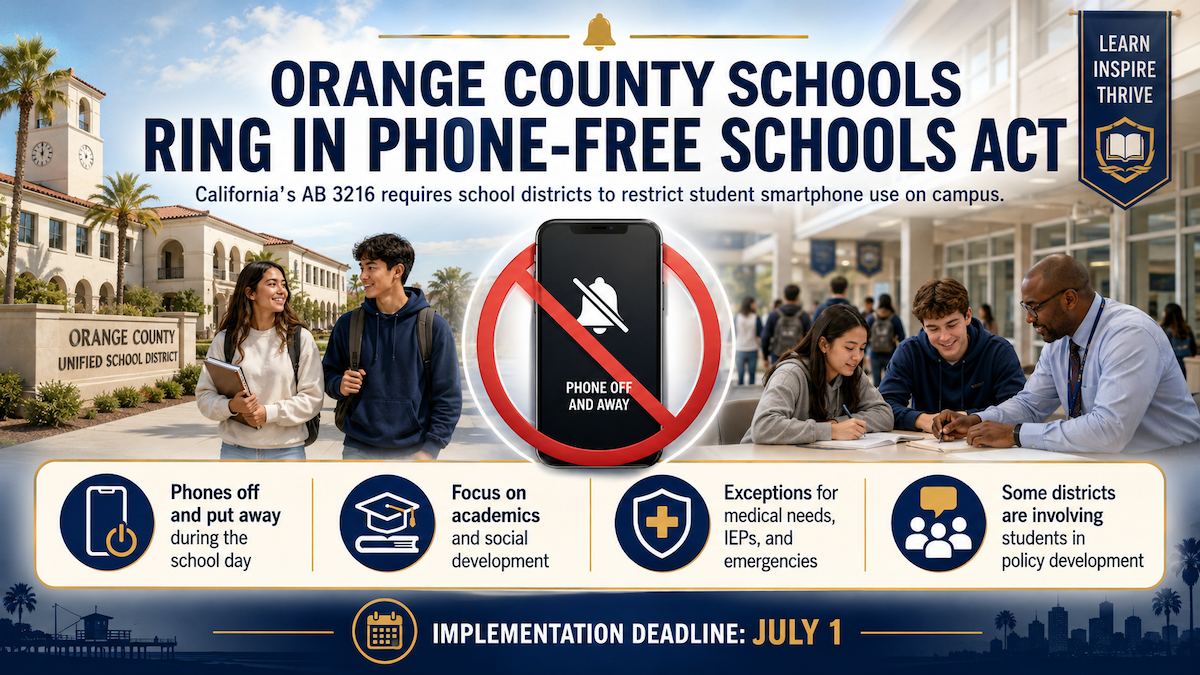
Public school students in Orange County are facing changes to daily campus life as local school districts work to limit cell phone access under California’s Assembly Bill 3216.
Known as the Phone-Free School Act, the state law requires schools across California to adopt an official policy that restricts student smartphone use on campus because they have the ability to distract from learning.
When Gov. Newsom signed the bill into law, he said in a statement, “This new law will help students focus on academics, social development, and the world in front of them, not their screens, when they’re in school.”
The Phone-Free School Act Implementation Deadline Was July 1, 2026
As a result of the deadline, educators are focusing on balancing the law’s requirements with the everyday student experience.
The Placentia-Yorba Linda Unified School District (PYLUSD) board policy defines the school day as the time a student arrives on campus until the end of their instructional day.
PYLUSD school officials are bringing students into the policy development process.
“Our goal is to move beyond simply identifying challenges and instead empower students to help shape practical solutions,” PYLUSD spokesperson Lorely Meza told OrangeCountyLawyers.com.
During the 2026–27 school year, student leaders will work alongside district administrators to provide input on policy language, implementation strategies, and the overall student experience.
In fact, Meza notes the Superintendent’s Student Leadership Board (SSLB) is currently in the process of reviewing current practices and helping to develop recommendations for a more structured cell phone policy.
“We believe that involving students in the process will strengthen understanding, increase buy-in, and support successful implementation across our schools,” Meza said.
The Huntington Beach City School District (HBCSD) developed its district-wide cellphone policy in partnership with staff and families and was implemented at the start of the 2025-26 school year.
The policy has been well received by the school community, according to HBCSD communications coordinator Adriana Angulo.
“Under the policy, student phones are allowed on campus but must be turned off and put away during the school day,” Angulo told OrangeCountyLawyers.com.
The Fullerton School District (FSD) implemented its student cell phone policy two years ago at the start of the 2024-25 school year. FSD officials alerted parents about their policy in a memorandum dated July 30, 2024.
“This isn’t a new initiative for us,” FSD public information officer Juliette Funes told OrangeCountyLawyers.com about the Phone-Free School Act. There are exceptions in which students cannot be denied access to or use of a smartphone pursuant to the law.
They include health or medical needs, under Individualized Education Programs (IEP) or if a teacher authorizes device usage. “Exceptions are made for emergency situations,” Angulo added about HBCSD’s policy.
PYLUSD’s policy states that no student shall be prohibited from possessing or using an electronic device that has been determined and documented by a licensed physician and/or surgeon to be essential to the student’s health.
Limited Use Allowed for Health Related Purposes
However, the use is limited to health-related purposes.
“The district will continue to ensure that any future policy aligns with state requirements regarding medical needs, emergencies, and other legally permitted exceptions,” Meza added.
Originally, the California School Boards Association (CSBA) raised concerns about the Phone-Free School Act but once it became law, the CSBA issued a sample school board policy on mobile communication devices to help school districts comply.
One recommendation under the CSBA model template is that school districts require students to turn off smartphones, smartwatches, and other mobile devices and keep them out of sight during school hours.
Another is to set stricter limits for younger grades while offering optional flexibility for high school students during non-instructional times, such as lunch.
A third is to prohibit taking photos, recording audio or video, or using devices at any time in sensitive areas like restrooms and locker rooms.
The CSBA did not respond to requests for comment by the time of publication.

Juliette Fairley
Juliette Fairley covers legal topics for various publications including the Southern California Record, the Epoch Times and Pacer Monitor-News. Prior to discovering she had an ease and facility for law, Juliette lived in Orange County and Los Angeles where she pursued acting in television and film.
Join our private
Facebook Group and
ask
local lawyers
a question

Join Our Newsletter
Stay up to date with our latest news and updates.
Join our private Facebook Group and
ask local lawyers a question


Contact Details
ADVERTISING INQUIRIES ONLY 12900 Garden Grove Blvd #132, Garden Grove, CA 92843
(949) 518-0204

Disclaimer: This website is attorney advertising. The information provided on OrangeCountylawyers.com is not legal advice and OrangeCountylawyers.com is not a law firm or a lawyer referral service. No attorney-client or confidential relationship is formed by use of the site and form submissions made to attorney profiles are not confidential. The attorney listings on OrangeCountylawyers.com are paid and/or free attorney advertisements and do not in any way constitute a referral or endorsement by OrangeCountyLawyers.com, parent or affiliate companies, or any approved or authorized lawyer referral service. Your access of/to and use of this site is subject to additional Terms & Conditions. None of the content on this website constitutes a guarantee, warranty or prediction regarding the outcome of any legal matter.
Copyright © 2026 OrangeCountyLawyers.com