The California Probate Process: Things You Should Know
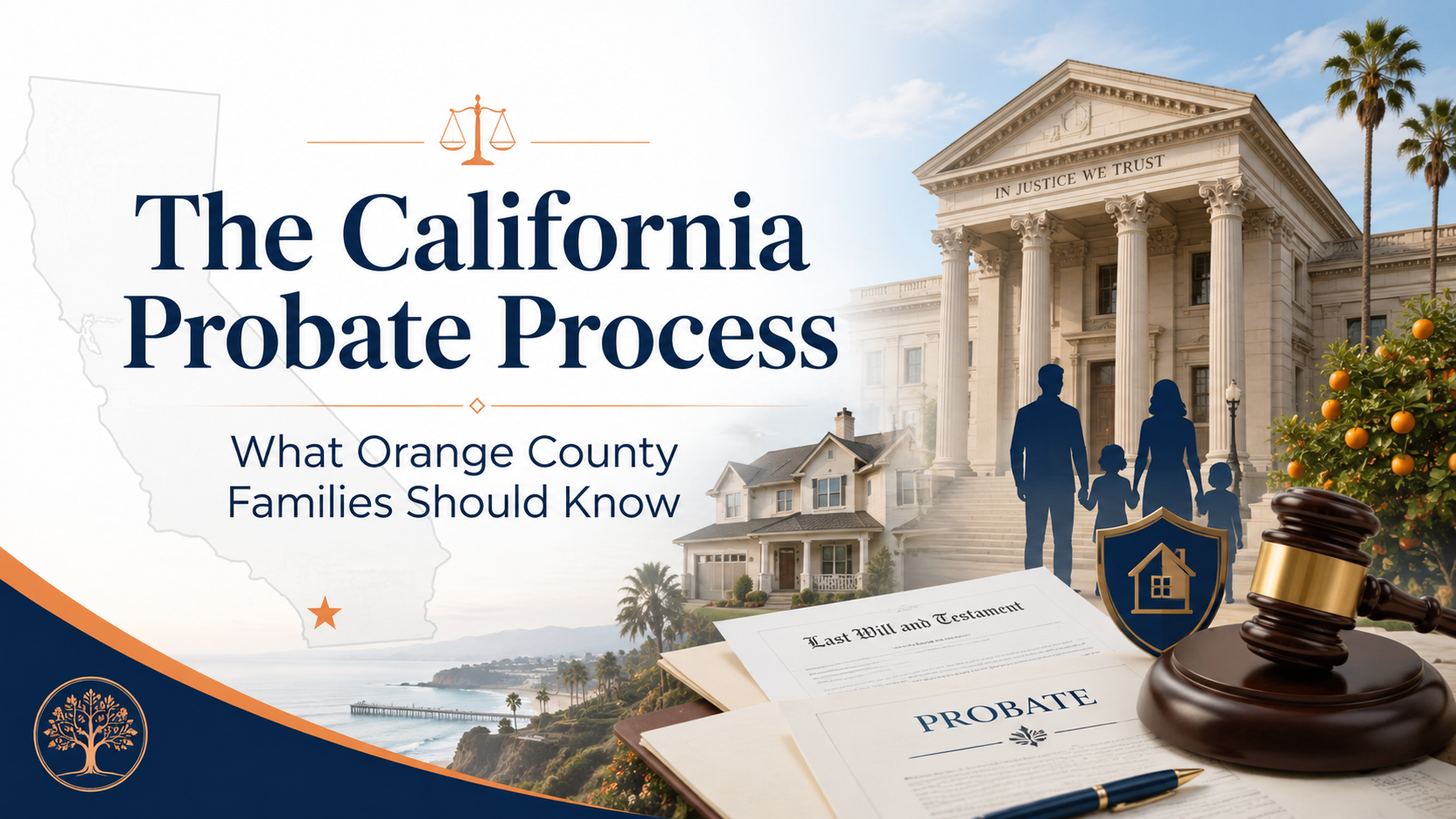
The California Probate Process: Things You Should Know
Probate is the court-supervised process used to transfer property after someone dies, pay valid debts, confirm the authority of a personal representative, and distribute remaining assets to heirs or beneficiaries. In California, probate may be required even when the deceased person had a will. A will tells the court who should receive property, but it does not automatically transfer title or avoid the probate process.
For Orange County families, probate is usually handled through the Orange County Superior Court Probate Division. The process can be straightforward when the estate is uncontested and the paperwork is complete, but it can become significantly more complicated when there are disputes over the will, creditor claims, real estate sales, missing heirs, or questions about the personal representative.
If you are in need of professional advice from a local Orange County probate lawyer, talk to an attorney experienced in the administration or litigation of a California probate matter.
Do You Need Probate in California?
Not every estate requires full probate. Before opening a probate case, families should first determine which assets are actually part of the probate estate.
Assets may avoid probate if they are held in a revocable living trust, owned in joint tenancy or community property with right of survivorship, payable to a named beneficiary, held in a retirement account with a valid beneficiary designation, or transferable through another non-probate procedure.
California also allows simplified procedures for certain smaller estates. For deaths on or after April 1, 2025, the small estate affidavit limit for qualifying personal property is $208,850. A separate court petition may be available for a California primary residence with a gross value of $750,000 or less. A separate real property of small value affidavit may apply when qualifying California real property does not exceed $69,625. These limits are based on the date of death and are expected to adjust again on April 1, 2028, unless the law changes.
Because the rules depend on the type of property, how title was held, the date of death, and the gross value of the property, families should be careful before assuming that a full probate is required.
The Six Phases of Probate in California
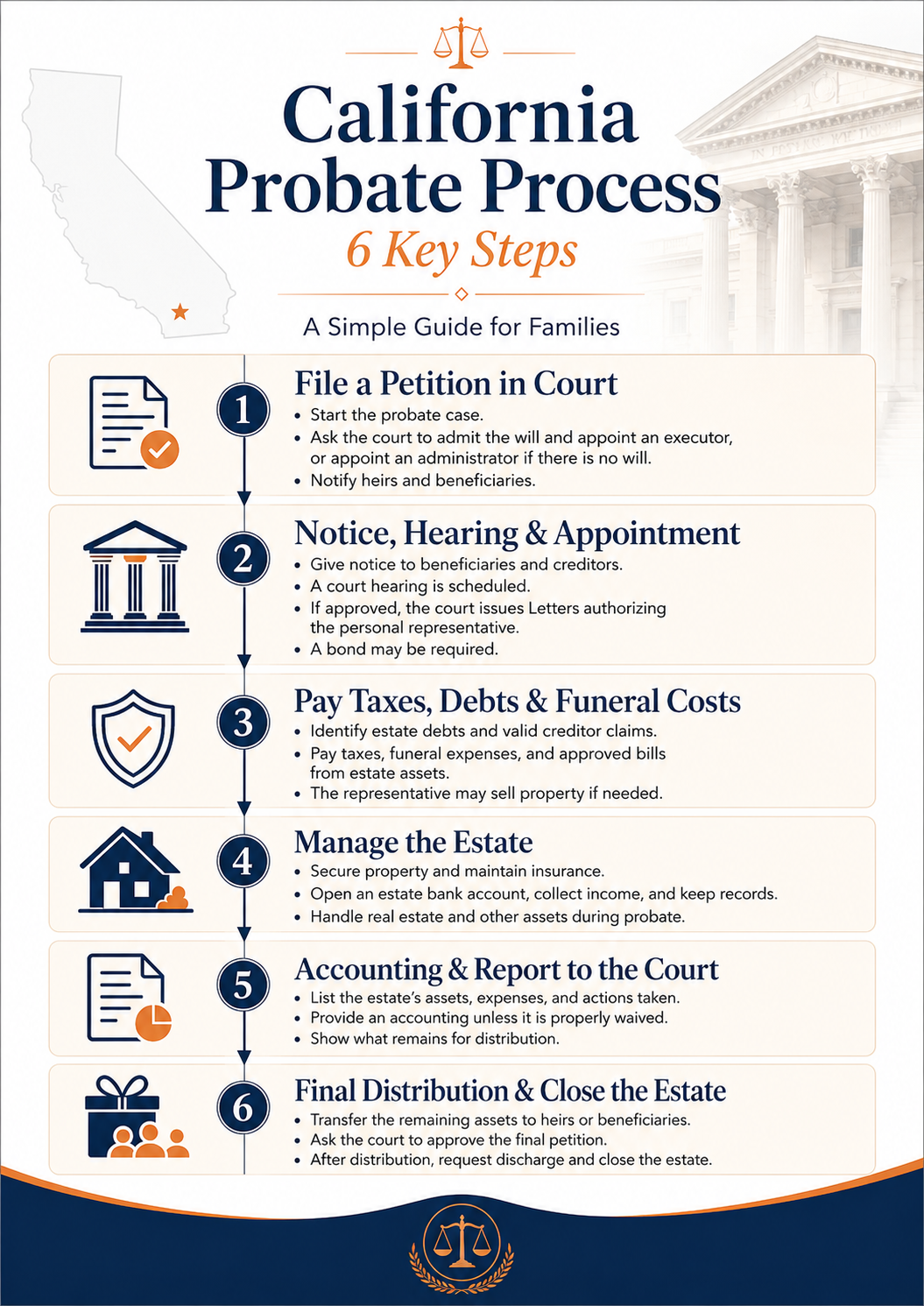
Download the infographic – Feel free to use and link to this article as the source.
The California probate process begins after the death of a person and is sometimes supervised by the courts. The probate process completes once all the liabilities are settled and assets distributed to the rightful owners. Sometimes, the probate process in Orange County, as well as throughout California, can take years and possibly even decades to complete, depending on the complexity and unique circumstances.
Step 1. Filing a Petition in the Court
The process begins when the surviving members of the deceased or their representatives file a petition in a probate court to do one of the following.
- Admit the will to probate and appoint an executor.
- If there is no will, appoint an administrator of the estate.
The notice of the hearing must be provided to all the heirs and beneficiaries of the estate. If one of the beneficiaries wants to object to the hearing, they have the opportunity to present their argument in court.
Step 2. Notice to Creditors and Court Hearings
The court will schedule a hearing to give all the stakeholders a chance to present their arguments. It is the petitioner’s responsibility to inform all the beneficiaries and creditors about the hearing and publish a legal notice in a local newspaper to alert them.
In cases where there is a will, the hearing is just a formality and the petitioner may not even need to show up. If the request is approved, the court will authorize an administrator to act on behalf of the estate. A letter of administration or letter of authority will be issued to make it official.
The court may require the petitioner to post a bond which serves as an insurance policy that the estate will be protected from any losses caused by the administrator.
The authenticity of the will may be challenged at this stage and the petitioner will need to prove that it is valid. A notarized statement signed by witnesses or court testimony from witnesses may be required to prove this.
Step 3. Taxes, Debts, and Funeral Expenses to Be Paid From the Estate
The estate administrator must clear all taxes owed by the decedent and pay for the funeral costs. The administrator must also determine which creditor claims are legitimate and pay the amounts owed to different parties. In some cases, the administrator is allowed to sell off the assets to clear the bills owed by the decedent.
The administrator is allowed to open a bank account in the name of the estate and use it to gather funds collected from the sale of estate assets. This account can be used to pay creditors and other expenses. It is not uncommon for probate cases to be open for several months before court decision and the administrator is allowed to settle creditor accounts for the duration of the probate process. The administrator must provide the court with a list of the deceased person’s property and proceeds from sale of assets.
Step 4. Transfer of Legal Title to Beneficiary
The final stage in probate cases is the settlement of the court case. This happens after reasonable time has been given to creditors to file claims and other expenses have been paid. The administrator must notify the court that the remaining assets are being transferred to the descendants in accordance with the will and court decision.
The administrator must also provide a detailed record of how the assets were managed during the probate period unless the beneficiaries waive this requirement.
Step 5: Managing the Estate During Probate
During probate, the personal representative has fiduciary duties to the estate and its beneficiaries. This may include securing real property, maintaining insurance, opening an estate bank account, collecting income, paying expenses, filing tax returns, preserving records, and avoiding conflicts of interest.
If real estate is involved, additional steps may be required before the property can be sold or transferred. Probate real estate sales can involve court confirmation unless the personal representative has authority under the Independent Administration of Estates Act and follows the required procedures.
Step 6: Accounting, Report, and Final Distribution
Before the estate can close, the personal representative usually files a final report and accounting with the court, unless the accounting is properly waived. This filing explains what assets were collected, what expenses were paid, what remains in the estate, and how the remaining property should be distributed.
Once the court approves the final petition, the personal representative can distribute the remaining assets to the proper beneficiaries or heirs. After distribution is complete, the personal representative can ask the court to discharge them from further responsibility.
Finding a Probate Lawyer
If you are just starting the probate process and are in search of legal assistance, contact the probate attorneys at Modern Wealth Law to discuss your matter.
OrangeCountyLawyers.com
Modern Wealth Law is an estate planning & probate law firm in Irvine, CA and serves clients throughout the entire Orange County region. John Wong is a California Bar Certified Specialist in estate planning, trusts and probate law and also handles matters including asset protection, trust administration and trust & estate litigation.
Join our private
Facebook Group and
ask
local lawyers
a question

Join Our Newsletter
Stay up to date with our latest news and updates.
Join our private Facebook Group and
ask local lawyers a question


Contact Details
ADVERTISING INQUIRIES ONLY 12900 Garden Grove Blvd #132, Garden Grove, CA 92843
(949) 518-0204

Disclaimer: This website is attorney advertising. The information provided on OrangeCountylawyers.com is not legal advice and OrangeCountylawyers.com is not a law firm or a lawyer referral service. No attorney-client or confidential relationship is formed by use of the site and form submissions made to attorney profiles are not confidential. The attorney listings on OrangeCountylawyers.com are paid and/or free attorney advertisements and do not in any way constitute a referral or endorsement by OrangeCountyLawyers.com, parent or affiliate companies, or any approved or authorized lawyer referral service. Your access of/to and use of this site is subject to additional Terms & Conditions. None of the content on this website constitutes a guarantee, warranty or prediction regarding the outcome of any legal matter.
Copyright © 2026 OrangeCountyLawyers.com